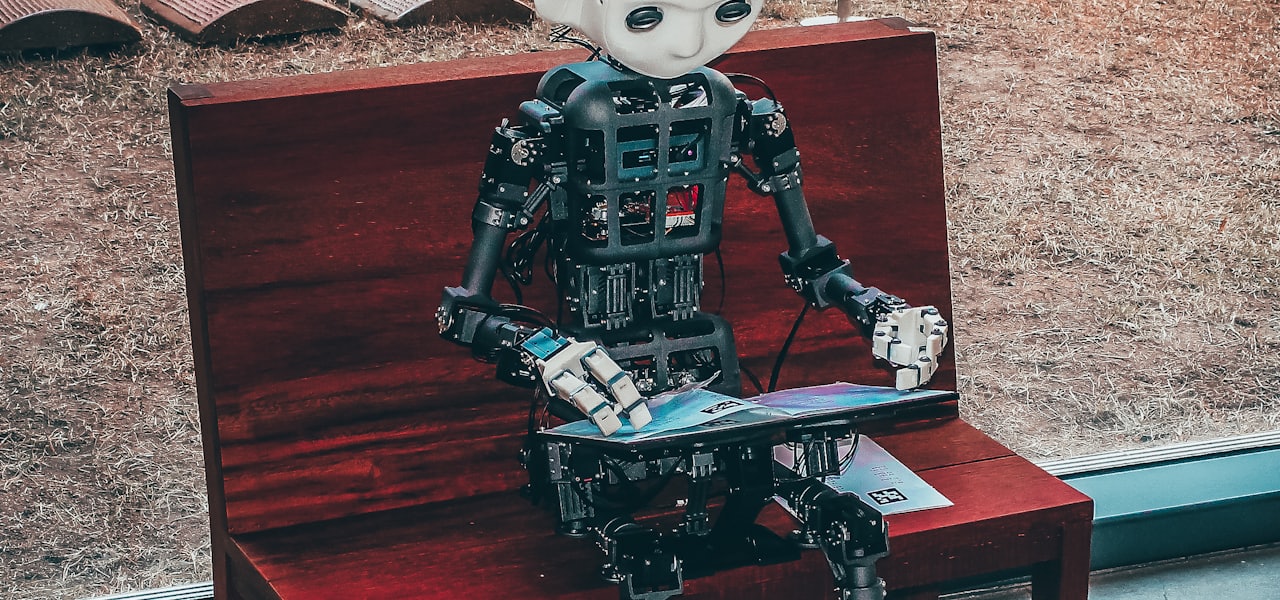
Imitation learning is a paradigm in reinforcement learning, where an agent learns to perform a task by supervised learning from expert demonstrations . It is also called learning from demonstration and apprenticeship learning. It has been applied to underactuated robotics, self-driving cars, quadcopter navigation, helicopter aerobatics, and locomotion. == Approaches == Expert demonstrations are recordings of an expert performing the desired task, often collected as state-action pairs ( o t ∗ , a t ∗ ) {\displaystyle (o_{t}^{},a_{t}^{})} . === Behavior Cloning === Behavior Cloning (BC) is the most basic form of imitation learning. Essentially, it uses supervised learning to train a policy π θ {\displaystyle \pi _{\theta }} such that, given an observation o t {\displaystyle o_{t}} , it would output an action distribution π θ ( ⋅ | o t ) {\displaystyle \pi _{\theta }(\cdot |o_{t})} that is approximately the same as the action distribution of the experts. BC is susceptible to distribution shift. Specifically, if the trained policy differs from the expert policy, it might find itself straying from expert trajectory into observations that would have never occurred in expert trajectories. This was already noted by ALVINN, where they trained a neural network to drive a van using human demonstrations. They noticed that because a human driver never strays far from the path, the network would never be trained on what action to take if it ever finds itself straying far from the path. === DAgger === DAgger (Dataset Aggregation) improves on behavior cloning by iteratively training on a dataset of expert demonstrations. In each iteration, the algorithm first collects data by rolling out the learned policy π θ {\displaystyle \pi _{\theta }} . Then, it queries the expert for the optimal action a t ∗ {\displaystyle a_{t}^{}} on each observation o t {\displaystyle o_{t}} encountered during the rollout. Finally, it aggregates the new data into the dataset D ← D ∪ { ( o 1 , a 1 ∗ ) , ( o 2 , a 2 ∗ ) , . . . , ( o T , a T ∗ ) } {\displaystyle D\leftarrow D\cup \{(o_{1},a_{1}^{}),(o_{2},a_{2}^{}),...,(o_{T},a_{T}^{})\}} and trains a new policy on the aggregated dataset. === Decision transformer === The Decision Transformer approach models reinforcement learning as a sequence modelling problem. Similar to Behavior Cloning, it trains a sequence model, such as a Transformer, that models rollout sequences ( R 1 , o 1 , a 1 ) , ( R 2 , o 2 , a 2 ) , … , ( R t , o t , a t ) , {\displaystyle (R_{1},o_{1},a_{1}),(R_{2},o_{2},a_{2}),\dots ,(R_{t},o_{t},a_{t}),} where R t = r t + r t + 1 + ⋯ + r T {\displaystyle R_{t}=r_{t}+r_{t+1}+\dots +r_{T}} is the sum of future reward in the rollout. During training time, the sequence model is trained to predict each action a t {\displaystyle a_{t}} , given the previous rollout as context: ( R 1 , o 1 , a 1 ) , ( R 2 , o 2 , a 2 ) , … , ( R t , o t ) {\displaystyle (R_{1},o_{1},a_{1}),(R_{2},o_{2},a_{2}),\dots ,(R_{t},o_{t})} During inference time, to use the sequence model as an effective controller, it is simply given a very high reward prediction R {\displaystyle R} , and it would generalize by predicting an action that would result in the high reward. This was shown to scale predictably to a Transformer with 1 billion parameters that is superhuman on 41 Atari games. === Other approaches === See for more examples. == Related approaches == Inverse Reinforcement Learning (IRL) learns a reward function that explains the expert's behavior and then uses reinforcement learning to find a policy that maximizes this reward. Recent works have also explored multi-agent extensions of IRL in networked systems. Generative Adversarial Imitation Learning (GAIL) uses generative adversarial networks (GANs) to match the distribution of agent behavior to the distribution of expert demonstrations. It extends a previous approach using game theory.
Amaq News Agency
Amaq News Agency (Arabic: وكالة أعماق الإخبارية, romanized: Wakālat Aʻmāq al-Ikhbārīyah) is a news outlet linked to the Islamic State (IS). Amaq is often the "first point of publication for claims of responsibility" for terrorist attacks in Western countries by the Islamic State. In March 2019, Amaq News Agency was designated as a foreign terrorist organization by the United States Department of State. == History == Among the founders of Amaq was Syrian journalist Baraa Kadek, who joined IS in late 2013, Abu Muhammad al-Furqan, and seven others who originally worked for Halab News Network. According to The New York Times, it has a direct connection with IS, from which it "gets tips". Its name was taken from Amik Valley in Hatay Province, which is mentioned in a hadith as the site of an "apocalyptic victory over non-believers". Amaq News Agency was first noticed by SITE during the Siege of Kobanî (Syria) in 2014, when its updates were shared among IS fighters. It became more widely known after it began reporting claims of responsibility for terrorist attacks in Western countries, such as the 2015 San Bernardino attack, for which IS officially claimed responsibility the next day. An Amaq cameraman shot the first footage of the capture of Palmyra in 2015. Amaq launched an official mobile app in 2015 and has warned against unofficial versions that reportedly have been used to spy on its users. It also uses a Telegram account. It had a WordPress-based blog, but it was removed without explanation in April 2016. On 12 June 2016, IS claimed responsibility for the Pulse nightclub shooting through Amaq, without prior knowledge of the attack. The shooter, Omar Mateen had later pledged allegiance to IS via a phone call with emergency services. On 31 May 2017, a Facebook post announced Amaq's founder, Baraa Kadek AKA Rayan Meshaal, had been killed with his daughter by an American airstrike on Mayadin. The post was reportedly made by his younger brother. Reuters could not immediately verify this account. On 27 July 2017, the US confirmed that Kadek had been killed by a coalition airstrike near Mayadin between 25 and 27 May 2017. In June 2017, German police arrested a 23-year-old Syrian man identified only as Mohammed G., accusing him of communicating with the alleged perpetrator of the 2016 Malmö Muslim community centre arson in order to report to Amaq. On 21 March 2019, the U.S. Department of State officially deemed Amaq an alias of IS, and thus a Foreign Terrorist Organization. On 22 March 2024, the Islamic State claimed responsibility for the Crocus City Hall attack through Amaq, U.S. officials confirmed the claim shortly after. A day after the attack, Amaq published a video of the attack, filmed by one of the attackers. It showed the attackers shooting victims and slitting the throat of another, while the filming attacker praises Allah and speaks against infidels. == Character == Amaq publishes a stream of short news reports, both text and video, on the mobile app Telegram. The reports take on the trappings of mainstream journalism, with "Breaking News" headings, and embedded reporters at the scenes of IS battles. The reports try to appear neutral, toning down the jihadist language and sectarian slurs IS uses in its official releases. Charlie Winter of the Transcultural Conflict and Violence Initiative at Georgia State University, and Rita Katz of SITE Intelligence Group in Washington say Amaq functions much like the state-owned news agency of IS, though the group does not acknowledge it as such. Katz said it behaves "like a state media". Amaq appears to have been allowed to develop by IS as a way to have a news outlet that is controlled by the group but is somewhat removed from it, giving IS more of the appearance of legitimacy. == Reliability == According to Rukmini Callimachi in The New York Times: "Despite a widespread view that the Islamic State opportunistically claims attacks with which it has little genuine connection, its track record—minus a handful of exceptions—suggests a more rigorous protocol. At times, the Islamic State has got details wrong, or inflated casualty figures, but the gist of its claims is typically correct." According to Callimachi, the group considers itself responsible for acts carried out by people who were inspired by its propaganda, as well as acts carried out by its own personnel and in some instances, had claimed attacks before the identities of the killers were known. Graeme Wood writing in The Atlantic in October 2017, wrote "The idea that the Islamic State simply scans the news in search of mass killings, then sends out press releases in hope of stealing glory, is false. Amaq may learn details of the attacks from mainstream media ... but its claim of credit typically flows from an Amaq-specific source." An October 2017 article in The Hill, points to two false claims made in the summer of 2017, the Resorts World Manila attack and a false claim that bombs had been planted at Charles de Gaulle Airport in Paris. Also, a claimed IS connection to the 2017 Las Vegas shooting proved to be false. According to Rita Katz on the SITE Intelligence Group website, calling a terrorist a "soldier of the caliphate (warrior from the caliphate)" in a statement issued by Amaq, was the usual way in which IS indicated that it inspired an attack. Centrally coordinated attacks were usually described as "executed by a detachment belonging to the Islamic State", and were often announced by both Amaq and by IS' central media command. == Online presence == In November 2019, Belgian police said they had carried out a successful cyberattack on Amaq, thus leaving IS without an operational communication channel. However, Amaq has since regained online presence, primarily on dark web platforms to make it harder for law enforcement to take them down without physical access to the server hosting the specific platform.
Pommerman Challenge
The Pommerman Challenge is a multi-agent game to test autonomous artificial intelligence systems. == Game structure == Two-agent team compete against each other on an 11 x 11 board. Each agent can observe only part of the board, and the agents cannot communicate. The goal is to knock down the opponents. Agents place explosives to destroy walls and collect power-ups that appear from those walls, while avoiding death. Game objects can move unpredictably or be moved by an agent. == Play == The game involves real-time decision making. Agents must choose moves in about .1 seconds. == Algorithms == The real-time requirement limits the use of compute-heavy techniques such as Monte Carlo tree search. The branching factor at each move can be as large as 1,296, because all four agents act in each step, choosing among six possibilities. The agents choose by accounting for explosions, which have lifetimes of 10 steps. Explosions derail tree search techniques, as searches with less than 10 levels ignore explosions while deeper searches consider too many choices (given the branching factor). A hybrid approach uses a limited-depth tree search followed by exploring a deterministic/pessimistic scenario. Limiting the depth keeps the search tree small. The deterministic approach can predict far in the future, by omitting branching. "Good" actions are often those that perform well under pessimistic scenarios, particularly if safety is important. Identifying the worst sequence of positions for an object can suggest where to move it. After generating pessimistic scenarios, the agent quantifies the survivability of each move, notionally the number of positions in which the agent can then remain safely (without encountering other agents). == Competitions == 3 competitions were organized with slightly changing rules during 2018–2019. === Online - FFA === This round was a warm-up online event, where each competitor controlled only one agent. Results: 1st: Agent47Agent by Yichen Gong 2nd: aiKiller by Márton Görög === NeurIPS 2018 - Team === The first Pommerman competition with in-person finals. Results: 1st: hakozakijunctions by Toshihiro Takahashi 2nd: eisenach by Márton Görög 3rd: dypm by Takayuki Osogami The 3 best performing solutions used online tree search. === NeurIPS 2019 - Team Radio === The second competition with in-person finals improved communication between teammate agents. Results: 1st: Márton Görög 2nd: Paul Jasek 3rd: Yifan Zhang
Jake Elwes
Jake Elwes () is a British media artist, hacker and researcher. Their practice is the exploration of artificial intelligence (AI), queer theory and technical biases. They are known for using AI to create art in mediums such as video, performance and installation. Elwes considers themselves to be neuroqueer, and their work on queering technology addresses issues caused by the normative biases of artificial intelligence. == Education and early life == Elwes was born in London to British contemporary artist and painter Luke Elwes and Anneke, daughter of Hans Dumoulin. Elwes is the great grandchild of Army officer James Hennessy and portrait painter Simon Elwes RA, son of Victorian opera singer Gervase Elwes. Elwes studied at the Slade School of Fine Art from 2013 to 2017, where they began using computer code as a medium. In 2016 they attended the School of Machines, Making & Make-Believe in Berlin with artist and educator Gene Kogan. Elwes was introduced to drag performance by their collaborator Dr Joe Parslow who holds a PhD in drag performance. Drag performance has since become instrumental to Elwes' work. == Career == Elwes' work with artificial intelligence is cited as a hopeful strategy to make AI more playful and diverse. Elwes' work has been exhibited in numerous international art museums and galleries and was featured in a BBC documentary on the history of video art, they were a 2021 finalist for the Lumen Prize, and received the Honorary Mention of the 2022 Prix Ars Electronica in the Interactive Art + category. They also curated and presented the opening provocation "The New Real - Artistic and Queer Visions of AI Futures" to the UK government with two drag artists at the AI UK conference 2024. Elwes is part of the Radical Faeries countercultural movement. They have exhibited in museums and galleries across Europe and Asia including: Victoria and Albert Museum (London, UK) - The Zizi Show (2023-2024) for the first digital commission in their photography center's digital gallery Pinakothek der Moderne (Munich, Germany) - Glitch. Die Kunst Der Störung (2023-2024) ZKM (Karlsruhe, Germany) - Biomedia (2021-2022) National Museum of Modern and Contemporary Art (Cheongju, South Korea) - What an Artificial World (2024) Somerset House (London, UK) - The Horror Show! (2022-2023) Gazelli Art House (London, UK) - Jake Elwes: Data • Glitch • Utopia (2023) (survey exhibition) Jut Art Museum (Taipei, Taiwan) - Future Lives, Future You (2023-2024) Max Ernst Museum (Brühl, Germany) - Surreal Futures (2023-2024) Zabludowicz Collection (London, UK) - Among the Machines (2022) Ars Electronica (Linz, Austria) - Prix Ars Electronica, CyberArts Exhibition (2022) Institute of Contemporary Arts (ICA) (London, UK) - Do Androids Dream on Silver Screens? (2023) Arebyte gallery (London, UK) - Real-Time Constraints (2020) Ming Contemporary Art Museum (McaM) (Shanghai, China) - Mind the Deep (2019) HMKV (Hartware MedienKunstVerein) (Dortmund, Germany) - House of Mirrors: Artificial Intelligence as Phantasm (2022) Today Art Museum (Beijing, China) - Future of Today: DEJA VU (2019) Science Gallery (Dublin, Ireland) - BIAS (2021-2022) Yuz Museum (Shanghai, China) - Lying Sophia and Mocking Alexa (2021) Fotomuseum Winterthur The Onassis Foundation (Athens, Greece) - You and AI (2021) Royal College of Art (London, UK) - Event Two (2019) (50th anniversary of Computer Arts Society & Event One) Museum für Naturkunde (Berlin, Germany) - Forschungsfall Nachtigall (2019) Frankfurter Kunstverein (Frankfurt, Germany) - I am here to learn (2018) Nature Morte (Delhi, India) - Gradient Descent (2018) BALTIC Centre for Contemporary Art (Newcastle, UK) - Bloomberg New Contemporaries (2017) == Artworks == === The Zizi Project - a deepfake drag cabaret === The Zizi Project is a series of works that explore the interaction of drag and A.I. Currently, The Zizi Project is made up of multiple artworks. ==== Zizi - Queering the Dataset (2019) ==== Knowing that facial recognition technology statically struggle to recognize black women or transgender people, Elwes set out to "Queer the Dataset" through an open-sourced generative adversarial network (GAN, a type of machine learning model and an early Generative artificial intelligence). Elwes added a dataset of 1,000 photos of drag kings and queens into the GAN's 70,000 faces collected in a standardised facial recognition dataset called Flickr-Faces-HQ Dataset (FFHQ). They then created new simulacra faces, known as deep fakes. "We queer that data so it shifts all of the weights in this neural network from a space of normativity into a space of queerness and otherness. Suddenly all of the faces start to break down and you see mascara dissolve into lipstick and blue eye shadow turn into a pink wig" said Elwes in a 2023 interview for Artnet. ==== Zizi & Me (2020–2023) ==== Zizi & Me is an ongoing multimedia collaboration between drag queen Me The Drag Queen and a deepfake A.I. clone of Me The Drag Queen. Using neural networks trained on filmed footage, the project creates a virtual body that can mimic reference movements. The first act, which features a digital lip-sync duet to Anything You Can Do (I Can Do Better), satirises the idea of A.I. being mistaken for a human, using drag performance and cabaret to critique societal narratives about A.I. and its role in shaping identity. The project is part of The Zizi Project by Jake Elwes, which explores the intersection of drag performance and A.I. ==== The Zizi Show - A Deepfake Drag Cabaret (2020) ==== The Zizi Show is a deep fake drag act based on artificial intelligence (AI). It has been presented live and as interactive online artwork. It is an exploration of queer culture and the algorithms philosophy and ethics of AI. The Zizi Show was exhibited as the inaugural exhibition in the digital gallery at the V&A’s Photography Center from 2023 to 2024. ==== Zizi in Motion: A Deepfake Drag Utopia (Movement by Wet Mess) (2023) ==== "Zizi in Motion" is a multichannel silent video installation featuring AI-generated deepfake performances, which are dynamically re-animated through the movements of London drag artist Wet Mess. The movements of Wet Mess cause the AI-generated visuals to glitch and distort, showcasing the interaction between drag performance and artificial intelligence. The work explore the potential for queer communities to ethically and creatively reclaim and repurpose deepfake technology, using it to celebrate queer bodies and identities. === Art in the Cage of Digital Reproduction (2024) === In an act of protest on 26 November 2024, Elwes facilitated indirect access to an early access token for OpenAI’s Sora text-to-video model through a Hugging Face frontend under the account "PR Puppets". The accompanying statement called to 'denormalize the exploitation of artists by major AI companies for training data, R&D, and publicity'. The incident attracted international press coverage calling into question the role of artists in shaping the future of generative AI versus merely serving as data and credibility providers for tech giants. Elwes also coordinated a collection of mini essays with responses and reflections from the signees and guest writers titled "Art in the Cage of Digital Reproduction". === Installations exploring interpretation and feedback loops between neural networks === Elwes has created works based on the interpretations and misinterpretations between different neural networks and training datasets including: A.I. Interprets A.I. Interpreting ‘Against Interpretation’ (Sontag 1966) from 2023, Closed Loop from 2017, and Auto-Encoded Buddha from 2016. ==== A.I. Interprets A.I. Interpreting ‘Against Interpretation’ (Sontag 1966) (2023) ==== A.I. Interprets A.I. Interpreting ‘Against Interpretation (Sontag 1966) is a three-channel video artwork where an AI interprets Susan Sontag’s essay into images, and then and another AI reinterprets those images back into language. The piece highlights how AI-generated art can misinterpret and introduce bias. ==== Closed Loop (2017) ==== Closed Loop is a two-channel video where two neural networks engage in a continuous feedback loop, one generating images based on the text output and the other creating text based on the image output. The work explores how AI models misinterpret and evolve in a surreal, self-perpetuating conversation, without human input. ==== Auto-Encoded Buddha (2016) ==== Auto-Encoded Buddha is a mixed-media piece where an AI attempts to generate an image of a Buddha statue, trained on 5,000 Buddha images. The AI struggles to accurately represent the Buddha, highlighting the limitations of early generative neural networks. The work is a tribute to Nam June Paik’s TV Buddha (1974). === CUSP (2019) === In their video work CUSP (2019) Elwes places marsh birds generated using artificial intelligence into a tidal landscape. These digitally generated and constantly shifting birds are recorded in dialogue with native
Shadowrun
Shadowrun is a science fantasy tabletop role-playing game set in an alternate future in which cybernetics, magic and fantasy creatures co-exist. It combines genres of cyberpunk, urban fantasy, and crime, with occasional elements of conspiracy, horror, and detective fiction. From its inception in 1989, it has spawned a franchise that includes a series of novels, a collectible card game, two miniature-based tabletop wargames, and multiple video games. The title is taken from the game's main premise – a near-future world damaged by a massive magical event, where industrial espionage and corporate warfare runs rampant. A shadowrun – a successful data theft or physical break-in at a rival corporation or organization – is one of the main tools employed by both corporate rivals and underworld figures. Deckers (futuristic hackers) can tap into an immersive, three-dimensional cyberspace on such missions as they seek access, physical or remote, to the power structures of rival groups. They are opposed by rival deckers and lethal, potentially brain-destroying artificial intelligences called "Intrusion Countermeasures" (IC), while they are protected by street fighters and/or mercenaries, often with cyborg implants (called cyberware), magicians, and other exotic figures. Magic has also returned to the world after a series of plagues; dragons who can take human form have returned as well, and are commonly found in high positions of corporate power. == Publication history == Shadowrun was developed and published by FASA from 1989 until early 2001, when the company closed and Shadowrun was transferred to WizKids, a company founded by former FASA employees. Two years before its closure, FASA sold its videogame branch, FASA Interactive, to Microsoft corporation, keeping rights to publishing novels and pen and paper RPGs. Since then, digital rights to Shadowrun IP have belonged to Microsoft. WizKids licensed the RPG rights to Fantasy Productions, who were already publishing a German version, until WizKids was acquired by Topps in 2003. Catalyst Game Labs, a publishing imprint of InMediaRes Productions, licensed the rights from Topps to publish new products. WizKids itself produced an unsuccessful collectible action figure game based on the property, called Shadowrun Duels. A fifth edition of Shadowrun was announced in December 2012. A limited-edition softcover was sold at the Origins Game Fair in June 2013, and the PDF in July 2013. A hardcover was published in August 2013. Shadowrun Anarchy was published in October 2016 It is a simplified version of the ruleset which allows focus more on the narration than on the rules. The sixth edition, called Shadowrun, Sixth World, was announced on May 1, 2019 to coincide with the game's 30th anniversary, along with a new website at shadowrunsixthworld.com. The game was published on August 26, 2019. The mechanics for this new version are generally similar to those of fifth edition, with some rules reworked for what line developer Jason Hardy describes as streamlining. This new version also progressed the in-game year to 2080. Since 2004, Shadowrun Missions (SRM) has offered fans "living campaigns" that allow for persistent character advancement. SRM is broken down into seasons which are made up of up to 24 individual missions that can be played at home, with special missions available to play exclusively at conventions. Each SRM season develops an overarching plot focused on a specific city from the Shadowrun setting. Missions settings have included the divided city of Denver, the corporate city-state of Manhattan, the Seattle Metroplex city-state, the formerly walled-off wastelands of Chicago, and Neo-Tokyo. For Shadowrun, Sixth World missions returned to Seattle, with twenty-four missions set in 2081, right after Seattle declared independence from the UCAS. The current Shadowrun Missions setting is 2083 New Orleans. The Shadowrun role-playing game has spawned several properties, including Shadowrun: The Trading Card Game, eight video games, an action figure game (Shadowrun Duels), two magazines, an art book and more than 50 novels, starting with the Secrets of Power series which introduces some of the original characters of Shadowrun and provides an introduction to this fictional universe. In addition to the main rule book there have been over 100 published supplements including adventures and expansions to both the rules and the game settings. Catalyst Game Labs announced that 2013 would be "The Year of Shadowrun," and in addition to the release of Shadowrun fifth edition that it has collaborated with publishers on the following properties: Shadowrun: Crossfire, The Adventure Deck-building Game; Shadowrun: Sprawl Gangers, a tactical miniatures wargame; and Shadowrun: Hostile Takeover, a board game designed by Bryan C.P. Steele was planned for release in late 2014/early 2015. Catalyst had been in collaboration with Nordic Games and Cliffhanger Studios to create Shadowrun Chronicles: Boston Lockdown online RPG, however it was shuttered November 30, 2018, with the producers citing lack of funding and the end of the license terms for use of the IP. == Fictional universe == Shadowrun takes place several decades in the future (2050 in the first edition, currently 2088). The end of the Mesoamerican Long Count calendar ushered in the "Sixth World", with once-mythological beings (e.g. dragons) appearing and forms of magic suddenly emerging. Large numbers of humans have "Goblinized" into orks and trolls, while many human children are born as elves, dwarves, and even more exotic creatures. In North America, indigenous peoples discovered that their traditional ceremonies allow them to command powerful spirits, and rituals associated with a new Ghost Dance movement let them take control of much of the western U.S. and Canada, where they formed a federation of Native American Nations. Seattle remains under U.S. control by treaty as a city-state enclave, and most game materials are set there and assume campaigns will use it as their setting. In parallel with these magical developments, the setting's 21st century features technological and social developments associated with cyberpunk science fiction. Megacorporations control the lives of their employees and command their own armies; many of the largest have extraterritoriality, such as currently enjoyed by foreign heads of state. Technological advances make cyberware (mechanical replacement body parts) and bioware (augmented vat-grown body parts implanted in place of or in tandem with natural organs) common. The Computer Crash of 2029 led to the creation of the Matrix, a worldwide computer network that users interact with via direct neural interface. When conflicts arise, corporations, governments, organized crime syndicates, and even wealthy individuals subcontract their dirty work to specialists, who then perform "shadowruns" or missions undertaken by deniable assets without identities or those that wish to remain unknown. The most skilled of these specialists, called shadowrunners, have earned a reputation for getting the job done. They have developed a knack for staying alive, and prospering, in the world of Shadowrun. The Shadowrun world is cross-genre, incorporating elements of both cyberpunk and urban fantasy. Unlike in a purely cyberpunk game, in the Shadowrun world, magic exists and has "worked" since 2011. Among other things, this split humankind into subtypes, also known as metatypes/metahumans. Some of these metatypes take the form of common fantasy races. Likewise, some animals have turned into familiar monsters of past fantasy and lore and both monsters and human magicians have regained magical powers. By the second half of the 21st century, in the time the game is set, these events are accepted as commonplace. Man, machine, and magic exist in a world where the amazing is among the most common and technology has entered into every facet of human (and metahuman) life. === Races === Characters in Shadowrun can be humans, orks, trolls, elves, dwarves, as well as certain diverging subspecies (known as metavariants) such as gnomes, giants, dryads, etc. In the early days, when magic returned to the world, humans began to either change into, or give birth to, elf and dwarf infants, a phenomenon called Unexplained Genetic Expression (UGE). Later, some juvenile and adult humans "goblinized" into other races (mostly orks, but also some trolls). The term "metahuman" is used either to refer to humanity as a whole, including all races, or to refer specifically to non-human races, depending on context. The return of Halley's Comet brought even further variation in the form of changelings, who have variation atypical to their metatype or even species, such as electroreception. Two of the metahuman races, elves and orks, have fictional languages. Additionally, a virus known as the Human Meta-Human Vampiric Virus (HMHVV), with many variant strains, has been known to cause f
Hugging Face
Hugging Face, Inc., is an American company based in New York City that develops computation tools for building applications using machine learning. Its transformers library built for natural language processing applications and its platform allow users to share machine learning models and datasets and showcase their work. == History == === Founding === The company was founded in 2016 by French entrepreneurs Clément Delangue, Julien Chaumond, and Thomas Wolf in New York City, originally as a company that developed a chatbot app targeted at teenagers. The company was named after the U+1F917 🤗 HUGGING FACE emoji. After open sourcing the model behind the chatbot, the company pivoted to focus on being a platform for machine learning. === AI boom === On April 28, 2021, the company launched the BigScience Research Workshop in collaboration with several other research groups to release an open large language model. In 2022, the workshop concluded with the announcement of BLOOM, a multilingual large language model with 176 billion parameters. In February 2023, the company announced partnership with Amazon Web Services (AWS) which would allow Hugging Face's products to be available to AWS customers to use them as the building blocks for their custom applications. The company also said the next generation of BLOOM will be run on Trainium, a proprietary machine learning chip created by AWS. In June 2024, the company announced, along with Meta and Scaleway, their launch of a new AI accelerator program for European startups. The initiative aimed to help startups integrate open foundation models into their products, accelerating the EU AI ecosystem. The program, based at STATION F in Paris, ran from September 2024 to February 2025. Selected startups received mentoring, and access to AI models and tools and Scaleway's computing power. On September 23, 2024, to further the International Decade of Indigenous Languages, Hugging Face teamed up with Meta and UNESCO to launch a new online language translator. It was built on Meta's No Language Left Behind open-source AI model, enabling free text translation across 200 languages, including many low-resource languages. In April 2025, Hugging Face announced that they acquired a humanoid robotics startup, Pollen Robotics, based in France and founded by Matthieu Lapeyre and Pierre Rouanet in 2016. In an X tweet, Delangue shared his vision to "make Artificial Intelligence robotics Open Source". === Cyberattacks === In early 2026, hackers hijacked the Hugging Face platform to launch Android-targeted attacks involving "powerful malware" which could completely take over a compromised target.
European Society for Fuzzy Logic and Technology
The European Society for Fuzzy Logic and Technology (EUSFLAT) is a scientific association with the aims to disseminate and promote fuzzy logic and related subjects (sometimes comprised under the collective terms soft computing or computational intelligence) and to provide a platform for exchange between scientists and engineers working in these fields. The society is both open for academic and industrial members. == History == EUSFLAT was founded in 1998 in Spain as the successor of the National Spanish Fuzzy Logic Society, ESTYLF, with the aim to open the society for members from other European countries. Since then, the society managed to attract a large share of members from outside Spain, and even beyond Europe, with the Spanish members still being the largest group inside EUSFLAT. For these historical reasons, the society is officially registered in Spain. == Conferences == Starting with 1999, EUSFLAT has been organizing its biannual conferences in odd years. Previous meetings: Palma de Mallorca, Balearic Islands, Spain, September 22–25, 1999 (jointly with National Spanish conference, ESTYLF) Leicester, United Kingdom, September 5–7, 2001 Zittau, Germany, September 10–12, 2003 Barcelona, Catalonia, Spain, September 7–9, 2005 (jointly with 11th Rencontres Francophones sur la Logique Floue et ses Applications) Ostrava, Czech Republic, September 11–14, 2007 Lisbon, Portugal, July 20–24, 2009 (jointly with 13th World Congress of the International Fuzzy Systems Association) Aix-les-Bains, France, July 18–22, 2011 (jointly with Les Rencontres Francophones sur la Logique Floue et ses Applications) Milan, Italy, September 11–13, 2013 Gijón, Spain, June, 30–3 July 2015 == Publications == EUSFLAT publishes the proceedings of its conferences in an open access manner. Until 2010, Mathware & Soft Computing was the official journal of EUSFLAT. On July 1, 2010, the International Journal of Computational Intelligence Systems (Atlantis Press, ISSN 1875-6891 (print) / ISSN 1875-6883 (on-line)) became the official journal of EUSFLAT. EUSFLAT publishes an electronic newsletter with three issues a year. == Presidents == EUSFLAT is led by the President, who is elected for a two-year period, and cannot serve for more than two consecutive periods. Francesc Esteva (1998–2011) Luis Magdalena (2001–2005) Ulrich Bodenhofer (2005–2009) Javier Montero (2009–2013) Gabriella Pasi (2013–present)